
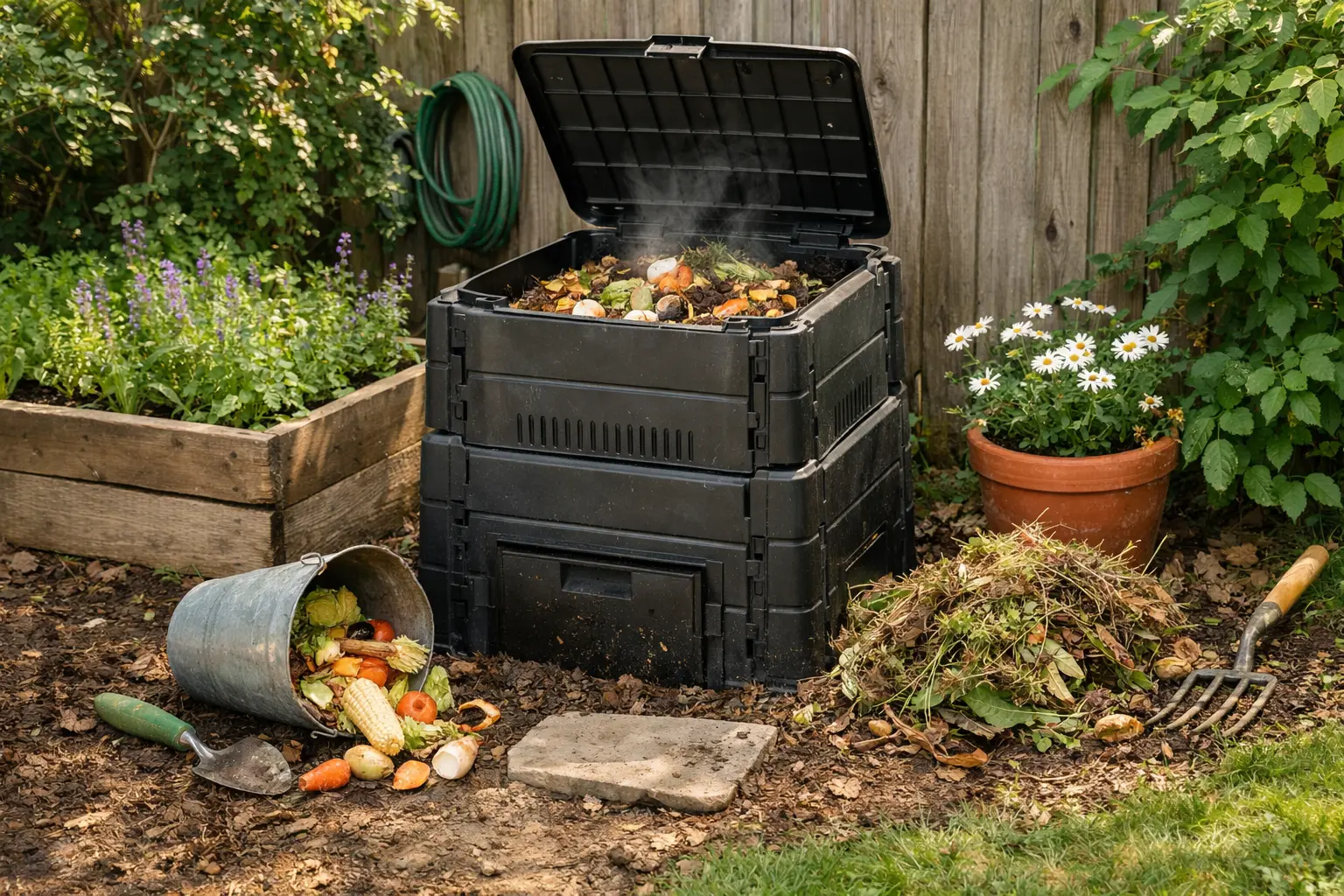
Why Composting at Home Makes Sense
Composting at home turns kitchen scraps and yard waste into nutrient-rich soil. It reduces household waste and improves garden health without chemical fertilizers.
For many households, composting is a low-cost way to cut trash, save money, and support local biodiversity.
How to Start Composting at Home: Quick Overview

Before you begin, pick a method that fits your space and time. You can use a simple pile, a tumbler, or a worm bin. Each method has different maintenance needs and speed.
Decide on a location, gather materials, and follow a basic routine of balancing green and brown inputs, turning, and monitoring moisture.
Choose a Composting Method for Home
Pick a system that matches your living situation. Small urban spaces benefit from vermicomposting or a compact tumbler. Suburban yards can handle bins or open piles.
- Compost bin: Good for beginners and backyard use. Low maintenance.
- Tumbler: Faster results with easier turning. Ideal for paved areas.
- Vermicompost (worm bin): Small, odor-controlled, excellent for apartment kitchens.
- Open pile: Works in larger yards but needs more space and time.
What to Compost at Home

Understanding what to add is key to success. Aim for a balance of nitrogen-rich “greens” and carbon-rich “browns.”
- Greens: fruit and vegetable scraps, coffee grounds, grass clippings.
- Browns: dry leaves, shredded paper, cardboard, straw.
- Avoid: meat, dairy, oily foods, diseased plants, and pet waste.
Step-by-Step: Setting Up a Home Compost System
Follow these steps to get started quickly and reliably. Each step takes only a short amount of time to set up.
- Select location: Choose a shady, level spot with good drainage.
- Prepare the base: Lay coarse material or a small pallet to allow airflow.
- Build layers: Start with a layer of browns, then add greens. Repeat layers to create balance.
- Turn and aerate: Turn the pile every 1–2 weeks, or use a tumbler more frequently.
- Monitor moisture: The compost should feel like a wrung-out sponge — damp but not dripping.
- Harvest: Finished compost is dark and crumbly. Use it in pots, beds, or as top dressing.
Composting at Home: Maintenance Tips
Simple maintenance prevents common problems. Regular turning adds oxygen and accelerates decomposition. Keep a simple ratio in mind: roughly 3 parts brown to 1 part green by volume.
- Chop larger items to speed breakdown.
- Add water in dry weather and cover in heavy rain.
- If it smells, add more browns and turn more often.

Composting can reduce household waste by up to 30 percent and improves soil structure, water retention, and plant health when used as a soil amendment.
Troubleshooting Common Issues in Composting at Home
Most issues have straightforward fixes. Identifying the cause helps you correct conditions quickly and keep composting on track.
Odor Problems
Bad smells usually mean too much green or poor aeration. Turn the pile and add dry browns like shredded paper or leaves.
Slow Decomposition
If decomposition is slow, check particle size, moisture, and temperature. Chop materials, moisten if dry, and add nitrogen-rich greens to raise activity.
Pests and Rodents
To deter pests, keep meat and oily foods out and use a closed bin or fine mesh. Bury food scraps under browns to reduce attraction.
Small Real-World Example: Suburban Kitchen to Garden
Sarah, a homeowner with a small yard, started a 200-liter compost bin near her vegetable garden. She collected kitchen scraps in a countertop caddy and added brown leaves from autumn.
After six months of regular turning and monitoring, she had rich compost that she mixed into raised beds. Her tomatoes grew more vigorously and she reduced weekly trash volume by about 25 percent.
How to Use Finished Compost from Home
Finished compost has many uses around the garden and home. It can be mixed into potting soil, used as mulch, or added to flower beds to boost nutrients.
- Mix into garden beds at a ratio of 1 part compost to 3 parts soil.
- Top-dress lawns with a thin layer to improve soil health.
- Use as potting mix amendment to improve water retention and structure.
Final Tips for Successful Composting at Home
Start small, monitor conditions, and adjust based on results. Composting is forgiving — small improvements lead to better outcomes over time.
Keep a simple toolkit: a pitchfork or turning tool, a kitchen caddy, and a moisture gauge if you like precision. With a little routine, composting becomes a natural part of household life.